Rehman Plaza, Sanda Khurd, Bund Road, Lahore, Pakistan

Pressure Reducing Valve

Pressure Reducing Valves — REW | Pakistan's Largest Valve Manufacturer Since 1948
REW Signature Product · PRV Series

Pressure Reducing Valves

Pilot Operated · Spring Loaded · Threaded · 15mm – 300mm

Automatic pressure control valves that reduce higher inlet pressure to a constant lower outlet pressure. Engineered to EN 1567 and BS 5167 standards — available in pilot operated, spring loaded, threaded and high-pressure configurations for water, steam, air and oil systems.

Size Range
15mm to 300mm
Pressure Class
PN10 PN40
Standards
EN 1567 · BS 5167
Body Material
CI · CS · SS
Pilot Operated Pressure Reducing Valve
Type 01 · PRV-PO
Pilot Operated PRV
Water Systems · Steam Lines · High-Pressure Service
Spring Loaded Pressure Reducing Valve
Type 02 · PRV-SL
Spring Loaded PRV
HVAC · Small Systems · Direct Acting Control
Threaded Pressure Reducing Valve
Type 03 · PRV-TR
Threaded PRV
Small Bore · Residential · Commercial Buildings
High Pressure PRV
Type 04 · PRV-HP
High Pressure PRV
Industrial · Steam · Oil & Gas Applications
REF · PRV-2026
ISO 9001:2015 Certified
EN 1567 · BS 5167 · API 609
100% Pressure Tested
Since 1948 · Lahore, Pakistan
79+ Years of Valve Engineering
ISO 9001:2015 Certified
EN 1567 · BS 5167 · API 609
100% Pressure Tested
Since 1948 · Lahore, Pakistan
79+ Years of Valve Engineering
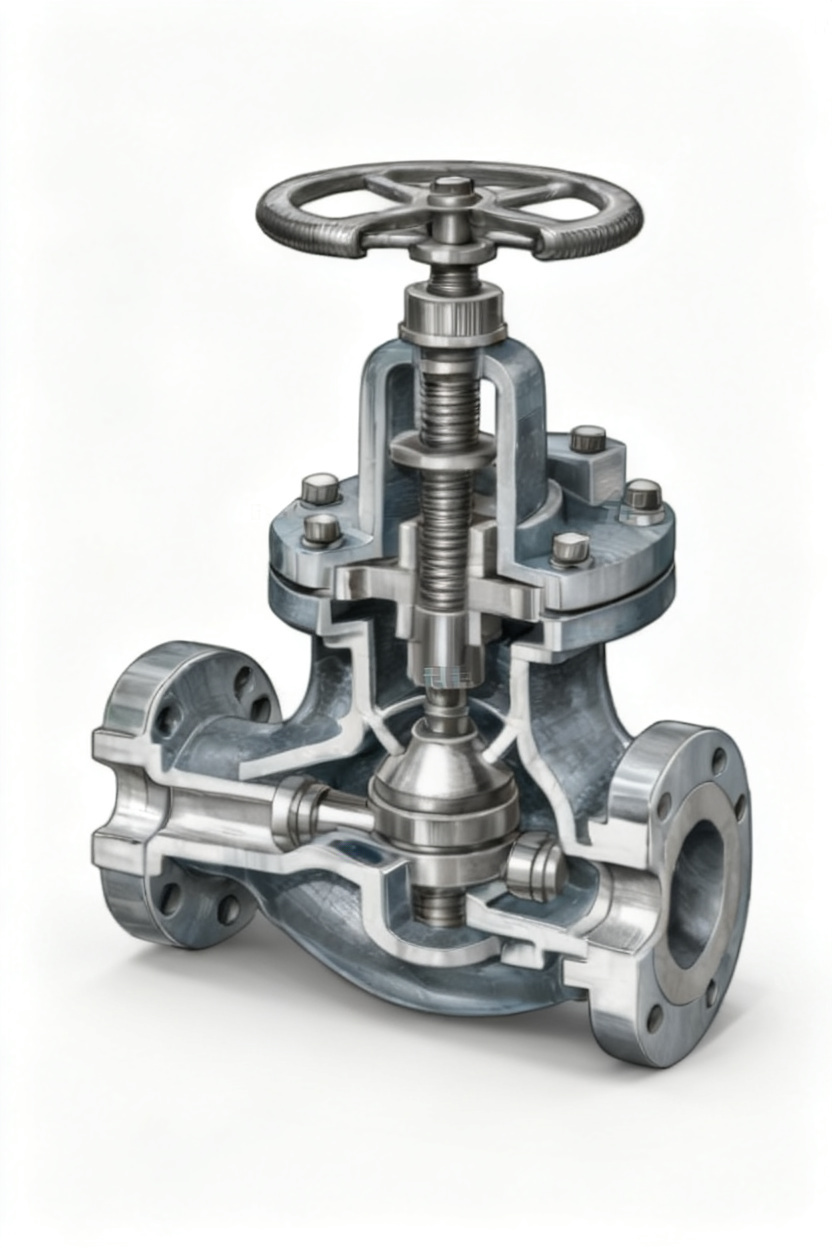
Pressure Reducing Valve Cross-Section
CROSS-SECTION · 01
Product Overview

The Guardian of System Pressure

A pressure reducing valve is a self-actuated control valve that automatically reduces a higher inlet pressure to a steady lower downstream pressure, regardless of changing flow rate or varying inlet pressure. It requires no external power — making it the most reliable solution for pressure management.

REW manufactures pressure reducing valves in four core configurations — Pilot Operated, Spring Loaded, Threaded and High Pressure types — per EN 1567 and BS 5167 standards, from DN15 to DN300, serving Pakistan's largest utilities, sugar mills, power plants and industrial facilities since 1948.

Automatic Regulation
Self-actuating — maintains constant outlet pressure without external power
Equipment Protection
Prevents overpressure damage to downstream piping and equipment
Precise Control
Accurate pressure setting adjustable from 0.2 to 7 bar outlet range
Energy Efficient
Reduces pumping costs and extends system life through optimal pressure
Product Variants

Four Core Configurations

Each engineered for specific pressure control challenges — from residential water systems to high-pressure industrial steam service.

Pilot Operated Pressure Reducing Valve
PRV-PO Type 01
Pilot Operated PRV
Globe type pilot operated pressure reducing valve uses a diaphragm actuator and pilot valve system to automatically maintain constant downstream pressure. The pilot senses outlet pressure through an impulse tube and modulates the main valve opening — no external power required.
Pilot sensing for precise pressure control
Diaphragm actuator for smooth modulation
Impulse tube for downstream pressure sensing
Adjustable outlet pressure 0.2 – 7 bar
Size: 50mm – 300mm (2" – 12") Pressure: PN10 – PN40 / Class 125 – 300 Material: CI, CS, SS Standard: EN 1567, BS 5167
Primary Applications
Water Systems Steam Lines High-Pressure Industrial
Request Quote
Spring Loaded Pressure Reducing Valve
PRV-SL Type 02
Spring Loaded PRV
Direct acting spring loaded pressure reducing valve for simpler installations. The spring force opposes the downstream pressure to maintain set point. Ideal for smaller systems and applications where pilot operation is not required.
Direct acting — no pilot required
Spring force opposes downstream pressure
Compact design for tight installations
Easy adjustment of set pressure
Size: 15mm – 150mm (½" – 6") Pressure: PN10 – PN25 / Class 125 – 150 Material: CI, CS, SS Standard: EN 1567, BS 5167
Primary Applications
HVAC Small Systems Residential Commercial
Request Quote
Threaded Pressure Reducing Valve
PRV-TR Type 03
Threaded PRV
Threaded end connection pressure reducing valve for small bore applications. BSP or NPT threaded ends for easy installation in residential, commercial and light industrial systems. Available in cast iron, cast steel and stainless steel body materials.
BSP / NPT threaded end connections
Easy installation without welding
Compact footprint for tight spaces
Available in CI, CS, SS body materials
Size: 15mm – 50mm (½" – 2") Pressure: PN10 – PN16 / Class 125 – 150 Material: CI, CS, SS Standard: EN 1567, BS 5167
Primary Applications
Residential Commercial Small Bore Light Industrial
Request Quote
High Pressure PRV
PRV-HP Type 04
High Pressure PRV
Cast steel body high pressure reducing valve for demanding industrial applications. Designed for steam, oil and gas service with pressure ratings up to PN40 / Class 300. Features robust construction with stainless steel trim for extended service life.
Cast steel body for high pressure service
Stainless steel trim for corrosion resistance
Suitable for steam, oil and gas service
Pressure ratings up to PN40 / Class 300
Size: 50mm – 300mm (2" – 12") Pressure: PN16 – PN40 / Class 150 – 300 Material: CS, SS Standard: EN 1567, BS 5167, API 609
Primary Applications
Steam Systems Oil & Gas Industrial High-Pressure
Request Quote
Manufacturing Process

Watch Our Production Line

From raw casting to final pressure testing — witness seven decades of valve engineering mastery in motion.
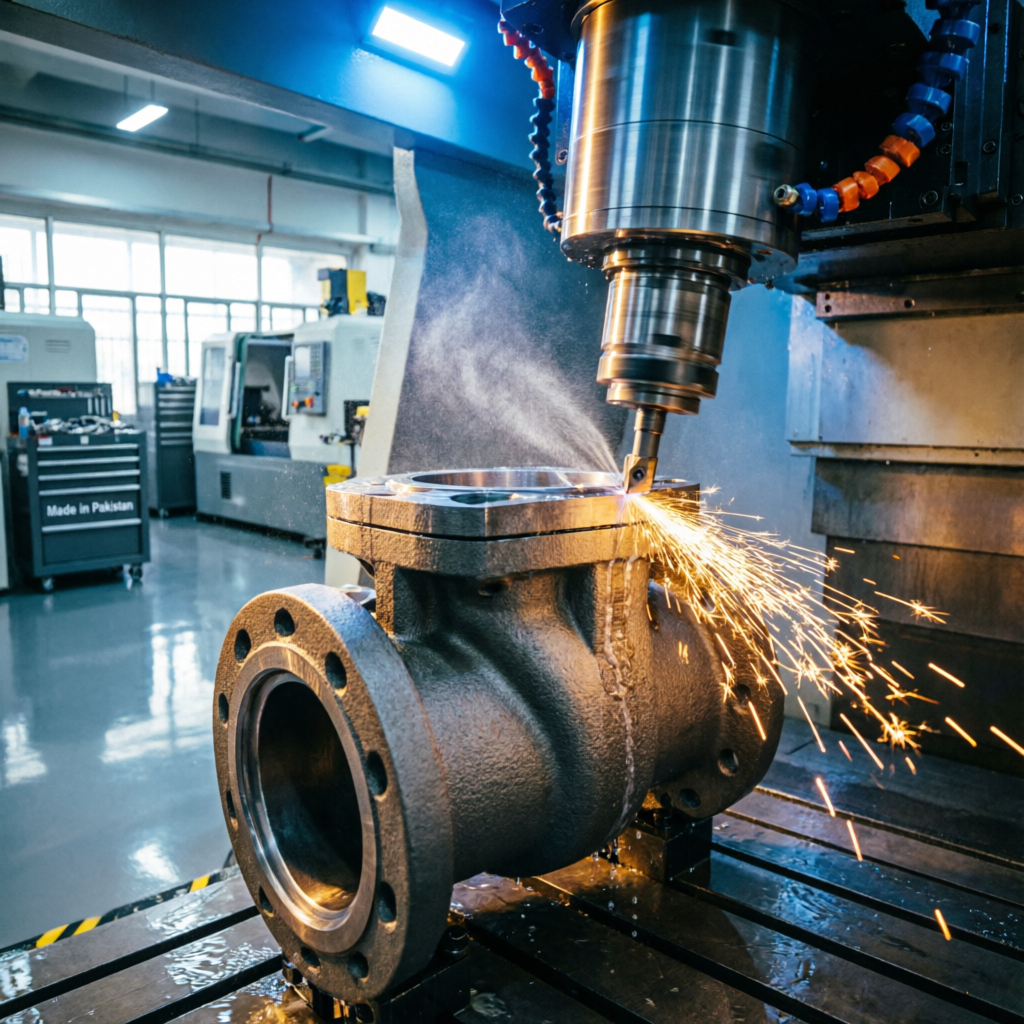
REW Manufacturing Facility

REW Pressure Reducing Valve Manufacturing

From casting to final testing — complete production process

Applications

Serving 40+ Industries

REW pressure reducing valves protect Pakistan's most critical pipeline infrastructure — from water utilities to sugar mills.

01
Water Supply
WASA, KWSB, municipal distribution, treatment plants
02
Hydropower
WAPDA projects, penstocks, turbine protection
HVAC
Chilled water, heating circuits, cooling towers
04
Chemical
SS valves for corrosive media, acid, alkali service
05
Sugar Mills
Juice heaters, process lines, condensate return
06
Oil & Gas
Refineries, pipelines, OGDCL, PPL, PARCO terminals
07
Power Generation
Hydro, thermal — WAPDA, K-Electric, NEPRA
08
Mining
Slurry lines, dewatering, mineral processing
09
Food Processing
Sanitary lines, CIP systems, steam sterilization
10
Textile
Dyeing, steam distribution, process water
11
Fire Protection
Hydrant systems, sprinkler mains, fire water storage
12
Wastewater
Sewage treatment, effluent handling, sludge lines
Working Principle

Automatic Pressure Control

Step-by-step operation sequence of a REW pilot operated pressure reducing valve — from high inlet to controlled outlet pressure.

Pressure Reducing Valve Technical Drawing
01
High Pressure Inlet
Fluid enters the valve body at higher upstream pressure (up to 16 bar / 150 psi). The main valve disc is held closed by spring force and downstream pressure acting on the diaphragm.
02
Pilot Sensing
Pilot valve monitors downstream pressure through impulse tube and compares to set point. When downstream pressure drops below set point, pilot opens to allow actuating fluid to the diaphragm chamber.
03
Automatic Modulation
Actuator diaphragm adjusts main valve opening proportionally to maintain constant outlet pressure. The valve modulates continuously to respond to changing flow demands.
04
Stable Output
Reduced pressure exits at set value (0.2 – 7 bar adjustable) for safe downstream operation. The valve maintains this pressure regardless of inlet pressure variations or flow changes.
05
Overpressure Protection
If downstream pressure exceeds set point, the pilot closes and the main valve throttles or closes to prevent overpressure. This protects downstream equipment from damage.
06
Continuous Regulation
The valve continuously modulates to maintain set pressure — no external power, no manual intervention. 79 years of REW engineering ensures reliable operation across millions of cycles.
Pressure Reducing Valve Construction Cross-Section
CROSS-SECTION VIEW
Construction Details

Every Component Engineered

Detailed breakdown of each major component — function, material, and engineering importance.

Body
Primary pressure-containing component with flow passage. Cast in CI, CS or SS. Houses the seat ring and main valve disc.
Bonnet / Cover
Covers the body opening and provides access for disc inspection and maintenance. Bolted design with gasket seal for pressure integrity.
Main Disc / Plug
The primary closure element that modulates to control downstream pressure. SS or bronze construction for corrosion resistance.
Stem
Transmits diaphragm or spring force to the main disc. Stainless steel construction with precision machining for smooth operation.
Diaphragm
Flexible membrane (NBR/EPDM) that senses downstream pressure and actuates the main valve. Critical component for automatic regulation.
Pilot Valve
Small control valve that senses downstream pressure and modulates actuating fluid to the diaphragm chamber. SS or bronze construction.
Spring
Adjustable spring sets the desired outlet pressure. Spring force opposes diaphragm force to establish pressure set point.
Impulse Tube
Connects downstream piping to pilot valve for pressure sensing. SS 316 construction for corrosion resistance in all media.
Technical Specifications

The Engineering Ledger

Complete specification sheet for REW Pressure Reducing Valves — every dimension, material, and standard documented for your engineering team.

Pressure Reducing Valve · Full Specification
DOC · PRV-SPEC-2026
Product NamePressure Reducing Valve — Pilot Operated, Spring Loaded, Threaded, High Pressure
Size Range15 mm (½") to 300 mm (12")
Pressure RatingPN10, PN16, PN25, PN40 · Class 125, 150, 300
Body MaterialCast Iron (GG25), Carbon Steel (WCB/WCC), Stainless Steel (CF8/CF8M)
Disc / PlugSS304, SS316, Bronze — matched to body material and service media
Stem MaterialSS304, SS316 — precision machined for smooth operation
DiaphragmNBR, EPDM, Viton — selected based on media and temperature
SpringSpring Steel — adjustable for outlet pressure setting
Pilot ValveSS304, SS316, Bronze — for accurate pressure sensing
Impulse TubeSS316 — for corrosion resistance in all media
End ConnectionFlanged (EN 1092-2, ANSI B16.5) / Threaded (BSP/NPT)
Outlet Pressure Range0.2 – 7 bar (adjustable)
Operating Temp-10°C to +200°C (depending on material and diaphragm)
Design StandardsEN 1567, BS 5167, API 609
Face-to-FaceEN 558-1, ASME B16.10
Flange StandardBS 4504, ANSI B16.5, DIN 2501, EN 1092
Testing StandardEN 12266-1, API 598 — Shell & Seat Hydrostatic Test
Coating / PaintEpoxy Coated (250 microns DFT), Fusion Bonded Epoxy
ApplicationsWater, Steam, Air, Oil, Gas — Industrial and Commercial
CertificationISO 9001:2015 · ISO 14001:2015 · ISO 45001:2018 · PSQCA
OriginManufactured in Lahore, Pakistan — Since 1948
Engineering Standards

Compliance & Certifications

Every REW pressure reducing valve is manufactured and tested to internationally recognized standards.

EN 1567
European Standard
Industrial valves — Pressure reducing valves. Primary design standard for REW pilot operated and spring loaded PRVs.
BS 5167
British Standard
Specification for pressure reducing valves. Covers design, manufacture, testing and documentation for UK and Commonwealth markets.
API 609
American Petroleum Institute
Butterfly valves and pressure reducing valves. Covers design and testing for petroleum industry service applications.
EN 558-1
Face-to-Face Dimensions
Basic dimensions for face-to-face and center-to-face of industrial valves. Ensures dimensional interchangeability.
API 598
Valve Testing
Standard testing procedures for all valve types. Shell test at 1.5×, seat test at 1.1× working pressure.
BS 4504
Flange Standard
Circular flanges for pipes, valves and fittings. PN designated. Covers bolt patterns and dimensions.
ANSI B16.5
American Flange Standard
Pipe flanges and flanged fittings. Class 125, 150, 300 ratings for American market compliance.
EN 1092
European Flange Standard
Flanges and their joints. Circular flanges for pipes, valves, fittings and accessories, PN designated.
ISO 9001:2015
Quality Management
Quality management system certified by TÜV Austria. Every valve traceable from raw material to final test.
Pressure Ratings

Working & Test Pressures

Pressure-temperature ratings for REW pressure reducing valves across all standard pressure classes.

Pressure ClassWorking Pressure (bar)Shell Test (bar)Seat Test (bar)Temperature Limit
PN10101511-10°C to +120°C
PN16162417.6-10°C to +200°C
PN252537.527.5-10°C to +200°C
PN40406044-10°C to +200°C
Class 12514.521.816-10°C to +200°C
Class 15019.629.421.6-10°C to +200°C
Class 300507555-10°C to +200°C
Pressure Reducing Valve Dimensional Drawing
Dimensional Information

Size & Weight Data

Select a size to view detailed dimensional data for pilot operated pressure reducing valves. All dimensions in millimeters.

DN50
DN80
DN100
DN150
DN200
DN250
DN300
Nominal Size (DN)50 mm
Face-to-Face (L)230 mm
Height (H)350 mm
Flange Diameter165 mm
Bolt Circle125 mm
No. of Bolts4
Bolt DiameterØ19 mm
Weight (approx.)18 kg
The Forge

Forged with 79 Years of Mastery

From raw casting to final pressure testing — every REW pressure reducing valve passes through a rigorous manufacturing process refined over seven decades at our Lahore facility.

01
Pattern & Casting
Precision wooden/metal patterns, green-sand and shell-mould casting in CI, CS, SS
02
CNC Machining
CNC lathes and VMCs for seat, bore, flange and stem machining to ±0.02mm tolerance
03
Disc & Seat Lapping
Precision lapping of disc-to-seat interface for bubble-tight shut-off. Seat ring press-fit or welded
04
Diaphragm & Pilot Assembly
NBR/EPDM diaphragm installed with precision pilot valve. Impulse tube connected for pressure sensing
05
Pressure Testing
Shell test at 1.5×, seat test at 1.1× working pressure — per EN 12266-1 / API 598
06
Painting & Dispatch
Epoxy coating (250 microns DFT), marking, documentation pack with MTC and test certificate
REW CNC Machining Facility
FACILITY · LHR
CNC Machining · Lahore Plant
Quality Assurance

Zero-Defect Philosophy

Every valve undergoes rigorous inspection and testing before dispatch. Our quality system is certified to ISO 9001:2015 by TÜV Austria.
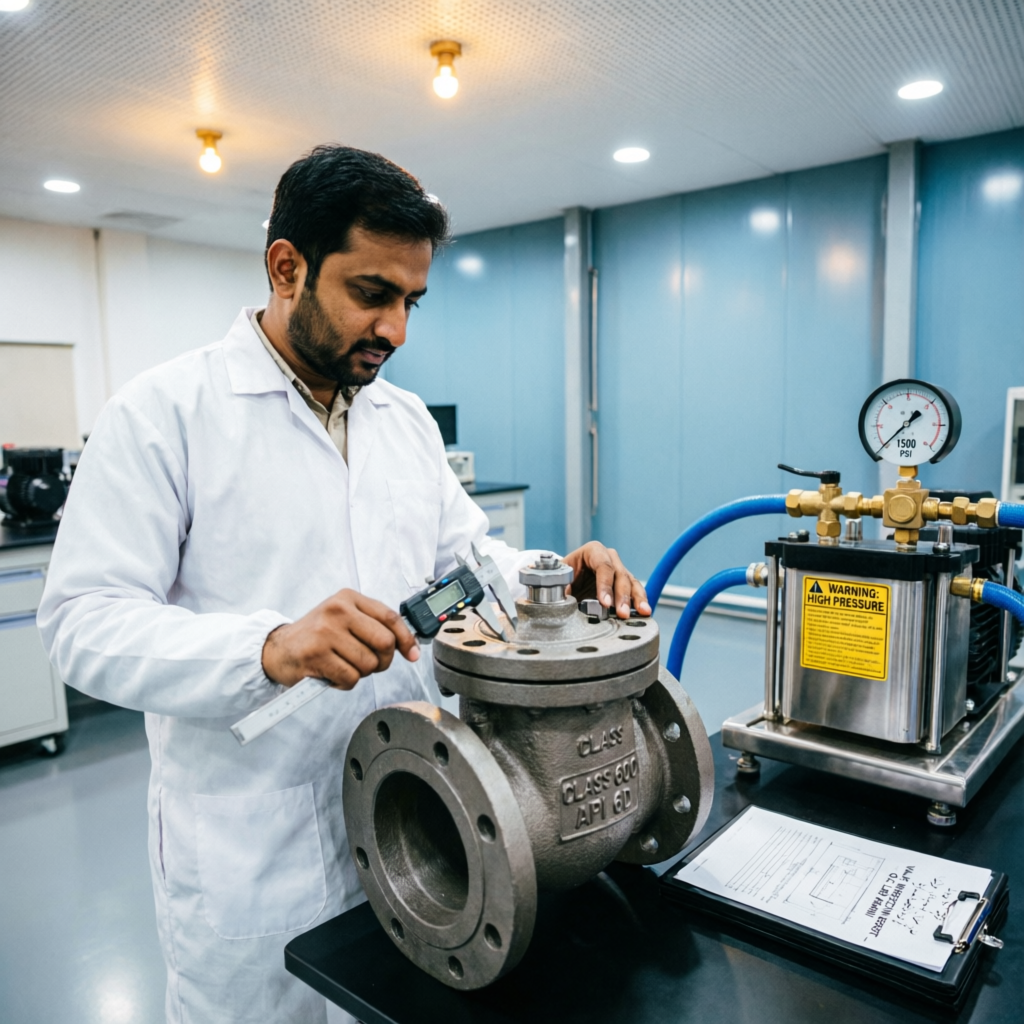
Incoming Inspection
Raw material verification — chemical composition and mechanical properties per EN 10204 3.1
Dimensional Inspection
CMM and precision instruments verify all critical dimensions against approved drawings
Hydrostatic Shell Test
1.5× working pressure held for specified duration. No visible leakage permitted
Seat Leakage Test
1.1× working pressure on seat. Zero visible leakage per EN 12266-1 / API 598
Pressure Regulation Test
Outlet pressure accuracy verified across full flow range. Set point stability confirmed
Coating Inspection
DFT measurement, adhesion test, holiday detection for epoxy coatings
Identification Marking
Size, pressure class, material grade, heat number, manufacturer logo — permanently marked
Documentation
MTC, test certificates, dimensional reports, painting certificates — complete traceability
REW Quality Assurance Laboratory
QA LAB · LHR
Technical Resources

Download Documentation

Complete technical documentation for engineering, procurement, and installation teams.

Technical Datasheet
Complete specifications, materials, dimensions, and performance data for all PRV variants.
PDF · 2.8 MB · Updated 2026
Download →
Product Catalogue
Full REW product range with technical data, applications, and ordering information.
PDF · 8.1 MB · 2026 Edition
Download →
Installation Manual
Step-by-step installation guide, orientation requirements, and commissioning procedures.
PDF · 1.8 MB · Multi-language
Download →
Maintenance Manual
Preventive maintenance schedules, diaphragm inspection, seat replacement, and overhaul procedures.
PDF · 3.2 MB · Illustrated
Download →
CAD Drawings
2D and 3D CAD files in DWG, STEP, and IGES formats for integration into your designs.
DWG/STEP · 12.5 MB · All sizes
Download →
Certificates
ISO 9001, ISO 14001, ISO 45001, PSQCA, and type approval certificates.
PDF · 5.6 MB · Certified copies
Download →
Test Reports
Sample hydrostatic test reports, material test certificates, and inspection records.
PDF · 4.1 MB · Sample documents
Download →
Selection Guide
Technical guide for selecting the right PRV type and size for your application.
PDF · 2.8 MB · Engineering guide
Download →
Installed Projects

Trusted Across Pakistan

REW pressure reducing valves installed in critical infrastructure projects nationwide.

Water Treatment Plant
Water Supply
Lahore Water Treatment Plant
Lahore, Punjab
120+
PRVs Installed
DN50-300
Size Range
2024
Completion
Oil Refinery
Oil & Gas
PARCO Oil Terminal Expansion
Mahmood Kot, Punjab
85+
PRVs Supplied
PN25
Pressure Class
2025
Phase 2
Power Plant
Power Generation
Muzaffargarh Power Station
Muzaffargarh, Punjab
65+
Steam PRVs
PN40
Pressure Class
2025
Completed
Sugar Mill
Sugar Mills
Chashma Sugar Mill Expansion
Mianwali, Punjab
95+
PRVs Installed
DN50-200
Size Range
2026
Ongoing
Technical FAQ

Engineering Questions

Answers to the most common technical questions about REW pressure reducing valves.

What is the difference between pilot operated and spring loaded PRVs?+
Pilot operated PRVs use a small pilot valve and diaphragm actuator for precise pressure control — ideal for larger sizes and higher accuracy requirements. Spring loaded PRVs use a direct-acting spring mechanism — simpler, more compact, ideal for smaller systems. Pilot operated offers better accuracy; spring loaded offers simpler installation.
What are the four types of pressure reducing valves REW manufactures?+
REW manufactures four core configurations: (1) Pilot Operated — diaphragm actuator with pilot sensing for precise control, (2) Spring Loaded — direct acting spring mechanism for simple installations, (3) Threaded — BSP/NPT threaded ends for small bore applications, (4) High Pressure — cast steel body for demanding industrial service.
What is the size range for REW pressure reducing valves?+
REW manufactures pressure reducing valves from DN15 to DN300 (½" to 12"). Threaded types available from 15mm to 50mm. Spring loaded types from 15mm to 150mm. Pilot operated and high pressure types from 50mm to 300mm.
What pressure ratings are available?+
REW pressure reducing valves are available in PN10, PN16, PN25, PN40 and Class 125, 150, 300. Outlet pressure is adjustable from 0.2 to 7 bar. Shell test is performed at 1.5× working pressure and seat test at 1.1× working pressure per EN 12266-1 and API 598 standards.
What standards do REW pressure reducing valves comply with?+
REW pressure reducing valves are manufactured to EN 1567 and BS 5167 standards. Face-to-face dimensions follow EN 558-1 and ASME B16.10. Flanges conform to BS 4504, ANSI B16.5, DIN 2501 and EN 1092. Testing is per EN 12266-1 and API 598.
What body materials are available?+
Standard body materials include Cast Iron (GG25), Carbon Steel (WCB/WCC), and Stainless Steel (CF8/CF8M). Diaphragms are available in NBR, EPDM, and Viton. Trim materials include SS304, SS316, and Bronze — matched to the service media.
Can PRVs be installed in any orientation?+
Most REW PRVs can be installed in horizontal or vertical upward flow orientation. Vertical downward flow installation is not recommended for pilot operated types. Always refer to installation manual for specific orientation requirements. Impulse tube connection must be accessible for pressure sensing.
How do I set the outlet pressure on a PRV?+
Outlet pressure is set by adjusting the spring compression using the adjustment screw on top of the valve. Turn clockwise to increase pressure, counter-clockwise to decrease. Use a pressure gauge on the downstream side to verify setting. Refer to installation manual for detailed procedure.
How often should pressure reducing valves be maintained?+
Recommended maintenance interval is 12-24 months depending on service conditions. Maintenance includes: diaphragm inspection, seat condition check, spring calibration, strainer cleaning (if equipped), and bolt torque verification. Harsh environments (steam, chemicals) may require more frequent maintenance.
What is the pressure testing procedure for REW PRVs?+
Every valve undergoes: (1) Shell test at 1.5× working pressure for specified duration — no visible leakage permitted. (2) Seat test at 1.1× working pressure — zero visible leakage per EN 12266-1. (3) Pressure regulation test — outlet pressure accuracy verified across full flow range. All tests documented with certificates.
Can REW manufacture custom-sized pressure reducing valves?+
Yes. REW can manufacture pressure reducing valves in custom sizes from DN15 to DN300, custom pressure classes, special materials, and non-standard face-to-face dimensions. Custom drawings are typically delivered within 48 hours of specification confirmation.
What is the typical lead time for PRV orders?+
Standard sizes (DN50-DN150): 2-4 weeks. Large sizes (DN200-DN300): 4-6 weeks. Special sizes or exotic materials: 6-10 weeks. Emergency orders can be expedited. Exact lead times confirmed at time of quotation based on current production schedule.
What diaphragm materials are available?+
REW offers NBR diaphragms for water and oil service up to 80°C, EPDM diaphragms for water and steam service up to 120°C, and Viton (FKM) diaphragms for chemical and high-temperature service up to 200°C. Diaphragm material is matched to the service media and temperature.
Do PRVs require a strainer upstream?+
Yes, it is highly recommended to install a strainer upstream of the PRV to protect the pilot valve and diaphragm from debris. REW can supply matched strainers. Regular strainer cleaning is part of routine maintenance to ensure reliable PRV operation.
What coating options are available?+
Standard coating is fusion-bonded epoxy (FBE) in blue or green, 250 microns DFT. Options include: bitumen coating for underground service, hot-dip galvanizing, bare finish, and custom RAL colors. Special coatings available for corrosive environments. Coating specification confirmed at time of order.
What documentation is provided with each shipment?+
Standard documentation includes: Material Test Certificate (MTC) per EN 10204 3.1, Hydrostatic Test Report (shell and seat), Dimensional Inspection Report, Painting/Coating Certificate, Certificate of Compliance, and Installation/Maintenance Manual. Third-party inspection certificates available on request.
What is the warranty period for REW PRVs?+
Standard warranty is 12 months from date of commissioning or 18 months from date of shipment, whichever occurs first. Warranty covers manufacturing defects in materials and workmanship. Extended warranty available on request for critical applications.
Are spare parts available for REW pressure reducing valves?+
Yes. Complete spare parts inventory maintained for all standard sizes. Available spares include: diaphragms, seat rings, springs, pilot valves, gaskets, bolts/nuts, and impulse tubes. Spare parts typically dispatched within 48-72 hours.
How do I select the correct PRV type?+
Selection depends on: (1) Size and pressure — pilot operated for larger sizes, spring loaded for smaller, (2) Accuracy required — pilot operated offers better accuracy, (3) Media — determines diaphragm material, (4) Installation space — threaded for tight spaces. Our technical team provides free selection guidance.
How do I request a quotation for pressure reducing valves?+
Submit your requirements via the quote form on this page, email rewpak@yahoo.com, or call +92 322 276 2222. Include: size, inlet/outlet pressure, material, type (pilot/spring/threaded/HP), diaphragm material, end connection, quantity, and application details. Technical team responds within 24 hours.
ISO 9001:2015
Quality Management · TÜV Austria
ISO 14001:2015
Environmental Management
ISO 45001:2018
Health & Safety Management
PSQCA Mark
Pakistan Standards Certified
Request a Quote

Specify Your Pressure Reducing Valve Requirement

Share your size, inlet/outlet pressure, material, type (Pilot/Spring/Threaded/HP) and quantity — our technical team will respond with specifications, lead time, and competitive pricing within 24 hours.

Quick Quote Request